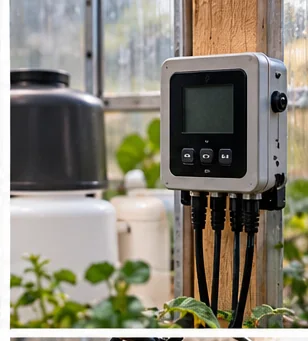
Products and configurations to compare
AC Infinity Controller 69 Pro
Current unit controls up to four devices with 12-ft probe and 2.4GHz Wi-Fi.
Best when: you use compatible variable-speed fans/lights and want coordinated climate logic
Watch for: UIS ecosystem compatibility matters and it is not a high-current heater relay
INKBIRD ITC-308 WiFi
Excellent for smaller heater/fan loads.
Best when: loads fit the controller rating and binary on/off control is enough
Watch for: 120V version is 10A/1200W total
Heavy-duty greenhouse thermostat contactor setup
Lets a low-current controller command properly sized switching hardware.
Best when: heater load exceeds plug-controller ratings
Watch for: should be designed/installed by qualified electrical help
Choose the control architecture before brands
Binary on/off equipment and variable-speed smart devices are different ecosystems.
Humidity/VPD features are only useful with correct sensors
Avoid mounting the probe in direct sun or mist.
Wi-Fi alerts are valuable for failures
Remote visibility can save seedlings during a heater trip.
Manual fallback matters
You should be able to run essential fans/heaters if the app/cloud is unavailable.
Keep high-current switching separate when necessary
Controllers do not magically increase circuit capacity.
Controllers only work as well as sensor placement
A temperature probe on a sunny metal frame reads something different from plant-canopy air. Hang probes in shaded moving air near the crop zone and away from heater discharge, wet media and cold glazing. The same rule applies to humidity/VPD sensors.
Simple plug-in thermostats are excellent when the job is binary: heater on below X, fan on above Y. Multi-device controllers become useful when lights, exhaust, circulation and humidification need coordinated triggers. Complexity should buy better control, not merely a prettier app.
Electrical ratings are hard limits
A controller rated for 1,200W total should not directly switch a 1,500W heater. Use only devices within voltage/current ratings and follow code/manufacturer requirements. Greenhouses are humid environments, so GFCI protection and weather-appropriate enclosures/connectors matter.
Before checkout
- Greenhouse dimensions and approximate volume are measured
- Climate goal is frost-free, cool-season or warm-crop winter growing
- Electrical circuit capacity and GFCI protection are confirmed
- Controller output rating exceeds connected load
- Ventilation has a real intake path, not only an exhaust fan
- Irrigation pressure/filtering matches emitters and tubing
- Light footprint matches the actual bench/canopy
- Seasonal materials can be removed or adjusted
- Replacement parts and consumables are available
- Automation can be overridden manually during a failure
The right upgrade solves the limiting factor
Greenhouses tempt owners to buy equipment one category at a time, but climate is a system. A bigger heater can be wasted through unsealed glazing. A giant exhaust fan can accomplish little without intake area. Perfect drip irrigation can still fail if the filter clogs. Before ordering, identify the variable that is actually leaving the safe crop range: overnight minimum temperature, afternoon maximum, humidity, root-zone moisture or daily light.
Spend first on measurement and failure prevention. A min/max logger, independent thermometer, pressure regulator or simple flow check can reveal that the existing equipment is adequate but badly controlled.
Commissioning the system
Test every automated device before plants depend on it. Force the thermostat above and below setpoint, manually trigger irrigation zones, watch an automatic vent through a warm day, simulate a power interruption where safe, and verify that fans have real intake air. Record the first week of minimum and maximum temperature/humidity so settings can be adjusted from evidence.
Greenhouse systems should also fail manually. Know which plug, valve or vent to operate if the controller loses Wi-Fi, a sensor breaks or a timer sticks. Simpler recovery is more valuable than another dashboard.
Frequently asked questions
What is VPD control?
It uses temperature and humidity relationships to target vapor-pressure deficit, a plant-transpiration metric.
Can Controller 69 Pro run a 1500W heater directly?
It is primarily a UIS device controller; use only supported devices/interfaces and correct load hardware.
Can ITC-308 run a 1500W heater?
Not the cited 120V version directly; its total output rating is 1200W.
Do I need Wi-Fi?
No, but alerts/remote monitoring can be useful.
Current product/source checks
Affiliate disclosure: GreenhouseGuide.co may earn from qualifying purchases through Amazon Associates and eBay Partner Network at no extra cost to you. Amazon links use scouttheory-20; eBay links use campaign 5339137014.