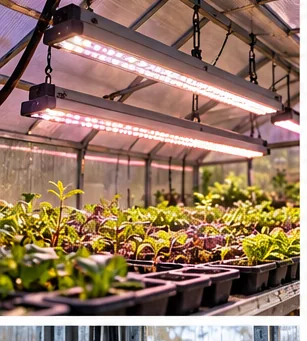
Products and configurations to compare
Spider Farmer SF1000 2026
Current draw is about 100W with 0–10V dimming.
Best when: you light a 2x2 seedling/greens bench
Watch for: fixture itself is not a whole-greenhouse light
Two 100W dimmable grow lights
Multiple fixtures can distribute light better.
Best when: you need more uniform coverage over 2x4+ area
Watch for: electrical moisture protection and hanging hardware matter
Grow-light timer / smart relay
Automation keeps day length consistent.
Best when: you supplement dawn/dusk or winter day length
Watch for: relay must be rated for combined fixture load
Measure the bench, not greenhouse
Supplemental light should be targeted to crop area.
Winter sunlight still contributes
Dim or schedule LEDs around natural daylight rather than running full power blindly.
Seedlings need uniformity
Stretching often comes from edge trays getting far less PPFD.
Dimming adds seasonal value
The same fixture can start gentle and ramp as seedlings mature.
Keep drivers/connectors dry
Greenhouse humidity and misting require careful placement.
Greenhouse grow lights supplement the sun
Unlike a closed grow tent, a greenhouse receives changing natural light. The useful question is daily light deficit: cloudy winter weeks, short photoperiods or densely shaded benches. Supplemental fixtures can extend day length or raise intensity during dark periods, but blasting full tent-level output at noon wastes electricity.
Match fixture footprint to benches, not greenhouse floor area. A 2×2-core fixture is ideal over a seedling bench and irrelevant to plants ten feet away. Multiple smaller fixtures often create better uniformity than one bright center fixture.
Water and electricity need deliberate separation
Hang lights securely, create drip loops, keep drivers/connectors away from irrigation and use appropriately protected electrical infrastructure. Do not assume an indoor grow light is weatherproof because it is marketed to growers.
Before checkout
- Greenhouse dimensions and approximate volume are measured
- Climate goal is frost-free, cool-season or warm-crop winter growing
- Electrical circuit capacity and GFCI protection are confirmed
- Controller output rating exceeds connected load
- Ventilation has a real intake path, not only an exhaust fan
- Irrigation pressure/filtering matches emitters and tubing
- Light footprint matches the actual bench/canopy
- Seasonal materials can be removed or adjusted
- Replacement parts and consumables are available
- Automation can be overridden manually during a failure
The right upgrade solves the limiting factor
Greenhouses tempt owners to buy equipment one category at a time, but climate is a system. A bigger heater can be wasted through unsealed glazing. A giant exhaust fan can accomplish little without intake area. Perfect drip irrigation can still fail if the filter clogs. Before ordering, identify the variable that is actually leaving the safe crop range: overnight minimum temperature, afternoon maximum, humidity, root-zone moisture or daily light.
Spend first on measurement and failure prevention. A min/max logger, independent thermometer, pressure regulator or simple flow check can reveal that the existing equipment is adequate but badly controlled.
Commissioning the system
Test every automated device before plants depend on it. Force the thermostat above and below setpoint, manually trigger irrigation zones, watch an automatic vent through a warm day, simulate a power interruption where safe, and verify that fans have real intake air. Record the first week of minimum and maximum temperature/humidity so settings can be adjusted from evidence.
Greenhouse systems should also fail manually. Know which plug, valve or vent to operate if the controller loses Wi-Fi, a sensor breaks or a timer sticks. Simpler recovery is more valuable than another dashboard.
Frequently asked questions
Is 100W enough?
For a small bench such as a 2x2 core area it can be, depending on natural light and crop.
What coverage does SF1000 claim?
Current Spider Farmer specs list 2x2 core and 3x3 maximum coverage.
Do seedlings need 18 hours?
Photoperiod depends on crop and intensity; use appropriate horticultural guidance rather than a universal tent schedule.
Can I hang indoor grow lights in a greenhouse?
Only if environmental exposure and electrical installation are appropriate for the product.
Current product/source checks
Affiliate disclosure: GreenhouseGuide.co may earn from qualifying purchases through Amazon Associates and eBay Partner Network at no extra cost to you. Amazon links use scouttheory-20; eBay links use campaign 5339137014.