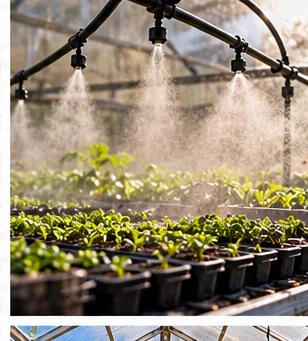
Products and configurations to compare
Greenhouse fine mist nozzle kit
Anti-drip check valves help reduce post-cycle dribble.
Best when: you build a bench-scale system
Watch for: hard water clogs tiny orifices
Seconds cycle timer + solenoid
Choose a timer that can cycle in seconds/minutes.
Best when: cuttings need frequent short pulses
Watch for: electrical/water installation must be protected
Sediment filter for misting system
Tiny nozzles need cleaner water than ordinary drip.
Best when: water contains particles or mineral debris
Watch for: filter requires cleaning
Misting frequency changes by weather
Sunny dry hours may require more frequent pulses than cool mornings.
Leaf wetness and humidity are related but different
Fine mist can evaporate into humidity or directly wet foliage depending on droplet size and airflow.
Bench coverage must overlap
Dry corners kill cuttings faster than the average reading suggests.
Drainage matters
Propagation media still needs to drain excess water.
Clean nozzles systematically
Keep spare nozzles and avoid random wire probing that changes orifice size.
Greenhouse irrigation should be zoned by plant need
Seedlings, tomatoes in large containers and a bench of herbs do not consume water at the same rate. A single long drip line with identical emitters can overwater one zone while another wilts. Divide the system into zones or use emitters matched to container size and crop demand.
Pressure regulation and filtration are the boring parts that make micro-irrigation reliable. Tiny emitters clog when dirty water enters the system, and household pressure can exceed what small tubing/fittings tolerate.
Automation should fail visibly
A timer or smart valve saves daily labor but can also run unnoticed after a split hose. Use shutoffs you can reach, inspect emitters regularly and place leak-prone manifolds where failures do not destroy electrical equipment or foundations.
Before checkout
- Greenhouse dimensions and approximate volume are measured
- Climate goal is frost-free, cool-season or warm-crop winter growing
- Electrical circuit capacity and GFCI protection are confirmed
- Controller output rating exceeds connected load
- Ventilation has a real intake path, not only an exhaust fan
- Irrigation pressure/filtering matches emitters and tubing
- Light footprint matches the actual bench/canopy
- Seasonal materials can be removed or adjusted
- Replacement parts and consumables are available
- Automation can be overridden manually during a failure
The right upgrade solves the limiting factor
Greenhouses tempt owners to buy equipment one category at a time, but climate is a system. A bigger heater can be wasted through unsealed glazing. A giant exhaust fan can accomplish little without intake area. Perfect drip irrigation can still fail if the filter clogs. Before ordering, identify the variable that is actually leaving the safe crop range: overnight minimum temperature, afternoon maximum, humidity, root-zone moisture or daily light.
Spend first on measurement and failure prevention. A min/max logger, independent thermometer, pressure regulator or simple flow check can reveal that the existing equipment is adequate but badly controlled.
Commissioning the system
Test every automated device before plants depend on it. Force the thermostat above and below setpoint, manually trigger irrigation zones, watch an automatic vent through a warm day, simulate a power interruption where safe, and verify that fans have real intake air. Record the first week of minimum and maximum temperature/humidity so settings can be adjusted from evidence.
Greenhouse systems should also fail manually. Know which plug, valve or vent to operate if the controller loses Wi-Fi, a sensor breaks or a timer sticks. Simpler recovery is more valuable than another dashboard.
Frequently asked questions
Can I use a patio mister?
Maybe for small hobby propagation, but uniformity/timer precision may be limited.
Do I need high pressure?
True fog systems do; simple propagation mist can work at lower pressure depending on nozzles.
How often should mist run?
Crop, rooting stage, humidity, light and nozzle output determine it; use observation and propagation guidance.
Does mist replace watering?
Not always; once roots develop, root-zone irrigation becomes more important.
Affiliate disclosure: GreenhouseGuide.co may earn from qualifying purchases through Amazon Associates and eBay Partner Network at no extra cost to you. Amazon links use scouttheory-20; eBay links use campaign 5339137014.