Products and configurations to compare
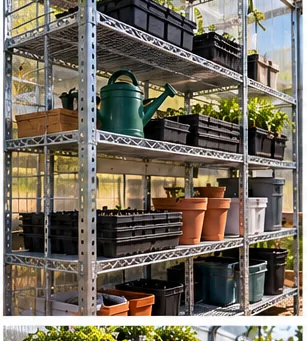
Galvanized wire greenhouse shelving
Open decks preserve light.
Best when: you grow trays/pots and want airflow
Watch for: thin wire can sag under heavy water-filled pots
Heavy-duty NSF wire shelf
Adjustable shelf spacing is valuable.
Best when: large pots or supplies need real capacity
Watch for: large commercial racks can dominate small greenhouses
Plastic greenhouse shelving
Light and easy to wash.
Best when: constant moisture is a concern
Watch for: lower load/stiffness on cheap units
Shelf depth should match trays
A 10x20 propagation tray wants enough front-to-back support without sticking into aisle.
Lower shelves become shade shelves
Use them for tools, empty pots or shade-tolerant crops.
Anchor tall shelving
Wind, uneven greenhouse floors and top-heavy pots can tip racks.
Rustproof does not mean immortal
Fasteners and cut galvanized edges may still corrode.
Leave airflow around glazing
Do not pack shelves flush against walls where condensation stays trapped.
Organization changes how much greenhouse you actually have
Shelving and benches add vertical growing area, but every solid shelf also casts shade. Use open wire shelves for propagation and storage, keep tall crops on the side that least blocks sun, and preserve aisle width. The best greenhouse layout lets you water, prune and carry trays without turning sideways.
Heavy water barrels and soil bins belong on foundations or floors that can carry the load. A 55-gallon barrel weighs roughly 460 pounds when full before including the barrel itself.
Thermal mass moderates; it does not create heat
Water barrels absorb solar heat during the day and release it as temperatures drop, which can reduce swings. They cannot replace active heat through a long cold cloudy period. Treat thermal mass as a buffer, not a perpetual heater.
Before checkout
- Greenhouse dimensions and approximate volume are measured
- Climate goal is frost-free, cool-season or warm-crop winter growing
- Electrical circuit capacity and GFCI protection are confirmed
- Controller output rating exceeds connected load
- Ventilation has a real intake path, not only an exhaust fan
- Irrigation pressure/filtering matches emitters and tubing
- Light footprint matches the actual bench/canopy
- Seasonal materials can be removed or adjusted
- Replacement parts and consumables are available
- Automation can be overridden manually during a failure
The right upgrade solves the limiting factor
Greenhouses tempt owners to buy equipment one category at a time, but climate is a system. A bigger heater can be wasted through unsealed glazing. A giant exhaust fan can accomplish little without intake area. Perfect drip irrigation can still fail if the filter clogs. Before ordering, identify the variable that is actually leaving the safe crop range: overnight minimum temperature, afternoon maximum, humidity, root-zone moisture or daily light.
Spend first on measurement and failure prevention. A min/max logger, independent thermometer, pressure regulator or simple flow check can reveal that the existing equipment is adequate but badly controlled.
Commissioning the system
Test every automated device before plants depend on it. Force the thermostat above and below setpoint, manually trigger irrigation zones, watch an automatic vent through a warm day, simulate a power interruption where safe, and verify that fans have real intake air. Record the first week of minimum and maximum temperature/humidity so settings can be adjusted from evidence.
Greenhouse systems should also fail manually. Know which plug, valve or vent to operate if the controller loses Wi-Fi, a sensor breaks or a timer sticks. Simpler recovery is more valuable than another dashboard.
Frequently asked questions
Is wire better than wood?
For wet greenhouse use, wire/plastic typically handle drainage and airflow better; treated/appropriate wood can work.
How wide should greenhouse shelves be?
Match standard trays and preserve aisle space.
Can I put seedlings on multiple tiers?
Only with supplemental lighting; upper tiers shade lower ones.
Should shelves be anchored?
Tall or top-heavy units should be secured appropriately.
Affiliate disclosure: GreenhouseGuide.co may earn from qualifying purchases through Amazon Associates and eBay Partner Network at no extra cost to you. Amazon links use scouttheory-20; eBay links use campaign 5339137014.