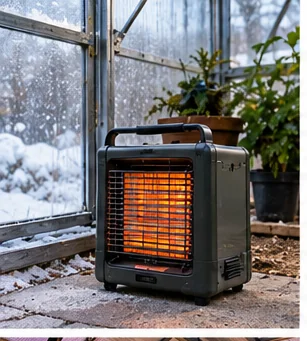
Products and configurations to compare
Bio Green Palma
Current Palma specs list 1500W and fan circulation.
Best when: you want Bio Green's thermostat ecosystem
Watch for: bundles differ and exact controller rating matters
Dr. Heater DR-218 1500W
Current 120V model is 1500W, IPX4 and fan forced.
Best when: you already have a properly rated external thermostat
Watch for: less greenhouse-specific control ecosystem
Heavy-duty greenhouse extension cord / outlet setup
Use only appropriately rated equipment and local-code-compliant installation.
Best when: receptacle placement is far from heater
Watch for: temporary cords are not a substitute for proper permanent wiring
Raw heat is essentially tied at 120V
Both convert about 1.5kW into heat.
Control strategy is the real difference
A precise external sensor in the plant zone can outperform an onboard thermostat near the heater.
Housing and airflow matter in wet spaces
Both emphasize greenhouse/workshop construction rather than bedroom styling.
The 3,000W DR-218 is a different electrical class
Its current 3kW version requires 240V/20A according to Dr. Heater.
One large cold greenhouse may need distributed heat
Multiple zones and better insulation can outperform one oversized hot spot.
Heat loss matters more than the heater label
A greenhouse is a deliberately leaky solar collector. Polycarbonate thickness, glazing seals, wind exposure, floor/perimeter losses and nighttime outside temperature determine how many watts or BTUs are required. A 1,500W electric heater can be excellent frost protection in a small insulated greenhouse and completely inadequate in a large single-wall structure at 0°F. Size from heat loss and target temperature, not square footage alone.
Before buying more heater, seal obvious drafts, add removable night insulation where practical and decide whether the goal is frost-free storage, cool-season growing or warm-season crops through winter. Keeping a greenhouse at 40°F is a radically different energy problem from holding 65°F.
Humidity rises when heating gets intermittent
Warm air holds more moisture; cold glazing condenses it. Gentle circulation and controlled ventilation are part of winter heating because stagnant humidity promotes disease and drips. A thermostat that simply cycles heat without air movement can create warm/cold pockets.
Before checkout
- Greenhouse dimensions and approximate volume are measured
- Climate goal is frost-free, cool-season or warm-crop winter growing
- Electrical circuit capacity and GFCI protection are confirmed
- Controller output rating exceeds connected load
- Ventilation has a real intake path, not only an exhaust fan
- Irrigation pressure/filtering matches emitters and tubing
- Light footprint matches the actual bench/canopy
- Seasonal materials can be removed or adjusted
- Replacement parts and consumables are available
- Automation can be overridden manually during a failure
The right upgrade solves the limiting factor
Greenhouses tempt owners to buy equipment one category at a time, but climate is a system. A bigger heater can be wasted through unsealed glazing. A giant exhaust fan can accomplish little without intake area. Perfect drip irrigation can still fail if the filter clogs. Before ordering, identify the variable that is actually leaving the safe crop range: overnight minimum temperature, afternoon maximum, humidity, root-zone moisture or daily light.
Spend first on measurement and failure prevention. A min/max logger, independent thermometer, pressure regulator or simple flow check can reveal that the existing equipment is adequate but badly controlled.
Commissioning the system
Test every automated device before plants depend on it. Force the thermostat above and below setpoint, manually trigger irrigation zones, watch an automatic vent through a warm day, simulate a power interruption where safe, and verify that fans have real intake air. Record the first week of minimum and maximum temperature/humidity so settings can be adjusted from evidence.
Greenhouse systems should also fail manually. Know which plug, valve or vent to operate if the controller loses Wi-Fi, a sensor breaks or a timer sticks. Simpler recovery is more valuable than another dashboard.
Frequently asked questions
Which puts out more heat at 120V?
Both referenced 120V units are 1,500W class.
Can I run either on a thermostat?
Yes when the control device is specifically rated for the heater load and application.
Is the DR-218 3000W model plug-and-play on 120V?
No; the manufacturer lists 240V/20A for the 3000W version.
Which is quieter?
Current official pages do not provide a directly comparable noise specification.
Current product/source checks
- Bio Green Palma greenhouse heater — current official specs
- Dr. Infrared Heater DR-218 — current official specs
Affiliate disclosure: GreenhouseGuide.co may earn from qualifying purchases through Amazon Associates and eBay Partner Network at no extra cost to you. Amazon links use scouttheory-20; eBay links use campaign 5339137014.