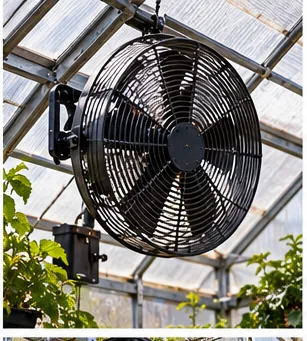
Products and configurations to compare
AC Infinity CLOUDLINE S6
Current spec is 425 CFM free-air, 30 dBA, 6-inch duct.
Best when: you want quiet speed-controlled exhaust with controller upgrade path
Watch for: inline duct installation needs intake/shutter planning
Greenhouse shutter exhaust fan
Wall fans reduce duct resistance.
Best when: you have a framed wall opening and want simple high airflow
Watch for: shutter sealing and weather exposure vary
Automatic intake louver
An exhaust fan needs somewhere for replacement air to enter.
Best when: exhaust fan lacks enough make-up air
Watch for: opening area must be large enough
Calculate greenhouse volume
Length × width × average height gives cubic feet; desired exchanges per minute translate to CFM.
Free-air ratings fall under restriction
Screens, shutters, duct bends and narrow inlets reduce delivered airflow.
Intake area can bottleneck the system
If doors slam or plastic bows inward, the intake is too restrictive.
Variable speed is useful in spring
You rarely need full hurricane mode all day.
Keep fan motor and wiring within environmental ratings
Humidity and irrigation mist are routine greenhouse exposures.
Ventilation and circulation are different systems
Exhaust ventilation exchanges greenhouse air with outdoors to remove heat and humidity. Circulation fans mix the air already inside to reduce hot spots, cold pockets and leaf-surface moisture. A greenhouse can need both. One giant fan blasting plants from the doorway is not equivalent to gentle horizontal airflow across the canopy.
Natural roof/louver vents are valuable because hot air rises and wax-cylinder openers work without grid power. Powered exhaust becomes more important when the structure has limited vent area or summer solar load overwhelms passive airflow.
Size fans for the actual enclosure
Fan CFM needs depend on greenhouse volume, intake opening, resistance through shutters/screens and desired air exchanges. An inline fan's free-air CFM is not necessarily what it delivers through long ducting or restrictive shutters.
Before checkout
- Greenhouse dimensions and approximate volume are measured
- Climate goal is frost-free, cool-season or warm-crop winter growing
- Electrical circuit capacity and GFCI protection are confirmed
- Controller output rating exceeds connected load
- Ventilation has a real intake path, not only an exhaust fan
- Irrigation pressure/filtering matches emitters and tubing
- Light footprint matches the actual bench/canopy
- Seasonal materials can be removed or adjusted
- Replacement parts and consumables are available
- Automation can be overridden manually during a failure
The right upgrade solves the limiting factor
Greenhouses tempt owners to buy equipment one category at a time, but climate is a system. A bigger heater can be wasted through unsealed glazing. A giant exhaust fan can accomplish little without intake area. Perfect drip irrigation can still fail if the filter clogs. Before ordering, identify the variable that is actually leaving the safe crop range: overnight minimum temperature, afternoon maximum, humidity, root-zone moisture or daily light.
Spend first on measurement and failure prevention. A min/max logger, independent thermometer, pressure regulator or simple flow check can reveal that the existing equipment is adequate but badly controlled.
Commissioning the system
Test every automated device before plants depend on it. Force the thermostat above and below setpoint, manually trigger irrigation zones, watch an automatic vent through a warm day, simulate a power interruption where safe, and verify that fans have real intake air. Record the first week of minimum and maximum temperature/humidity so settings can be adjusted from evidence.
Greenhouse systems should also fail manually. Know which plug, valve or vent to operate if the controller loses Wi-Fi, a sensor breaks or a timer sticks. Simpler recovery is more valuable than another dashboard.
Frequently asked questions
How many CFM do I need?
It depends on volume and climate; size from desired air exchanges and account for system resistance.
Is 425 CFM enough?
It can be substantial for a small greenhouse but may be inadequate for a larger structure in hot sun.
Do I need an intake fan too?
Often passive louvers are enough if sized properly; larger systems may use powered intake.
Can a grow-tent inline fan work?
Potentially, when temperature/humidity ratings and installation suit the greenhouse.
Current product/source checks
Affiliate disclosure: GreenhouseGuide.co may earn from qualifying purchases through Amazon Associates and eBay Partner Network at no extra cost to you. Amazon links use scouttheory-20; eBay links use campaign 5339137014.